Publicaties
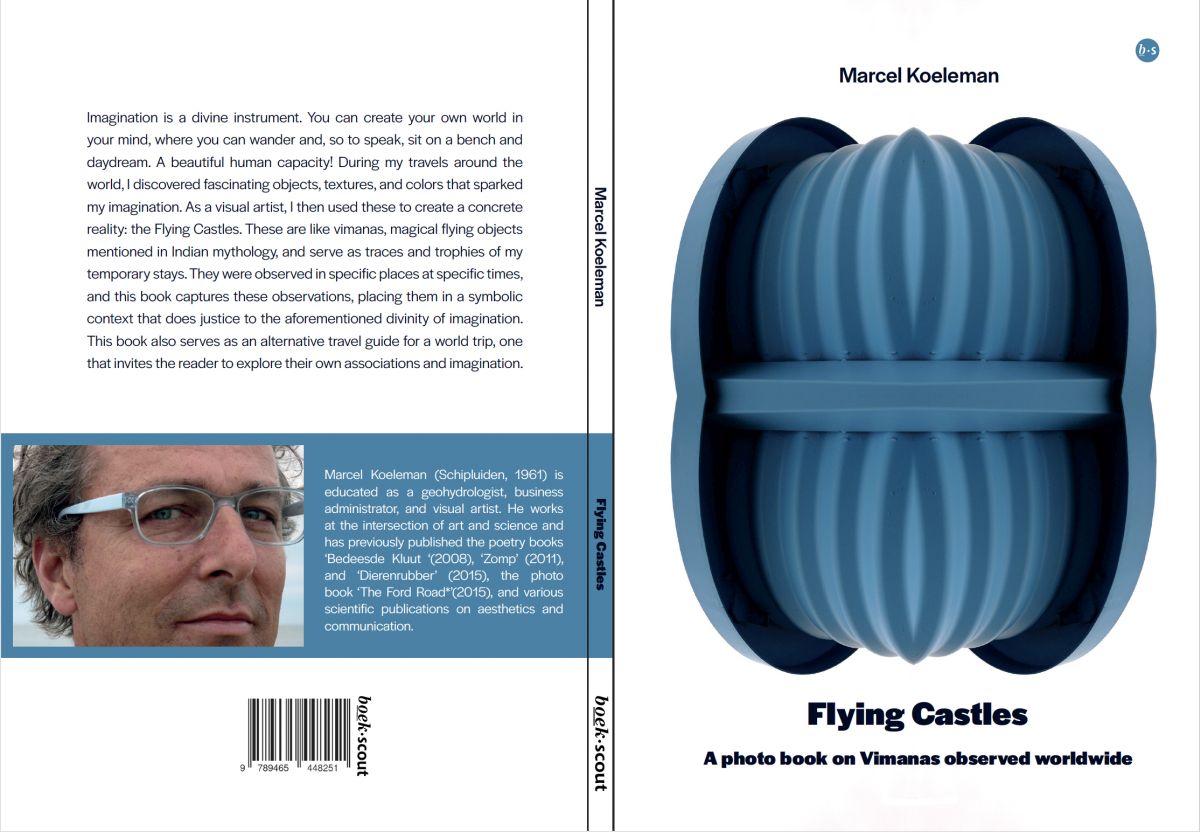
Flying Castles
A photo book on Vimanas observed worldwide
2026 (published by publisher BoekScout and available in bookshop and Amazon.com; in English, price 19,99 euro)
Imagination is a divine instrument. You can create your own world in your mind, where you can wander and, so to speak, sit on a bench and daydream. A beautiful human capacity! During my travels around the world, I discovered fascinating objects, textures, and colors that sparked my imagination. As a visual artist, I then used these to create a concrete reality: the Flying Castles. These are like Vimanas, magical flying objects mentioned in Indian mythology, and serve as traces and trophies of my temporary stays. They were observed in specific places at specific times. This book captures these observations, placing them in a symbolic context that does justice to the aforementioned divinity of imagination. This book also serves as an alternative travel guide for a world trip, one that invites the reader to explore their own associations and imagination.
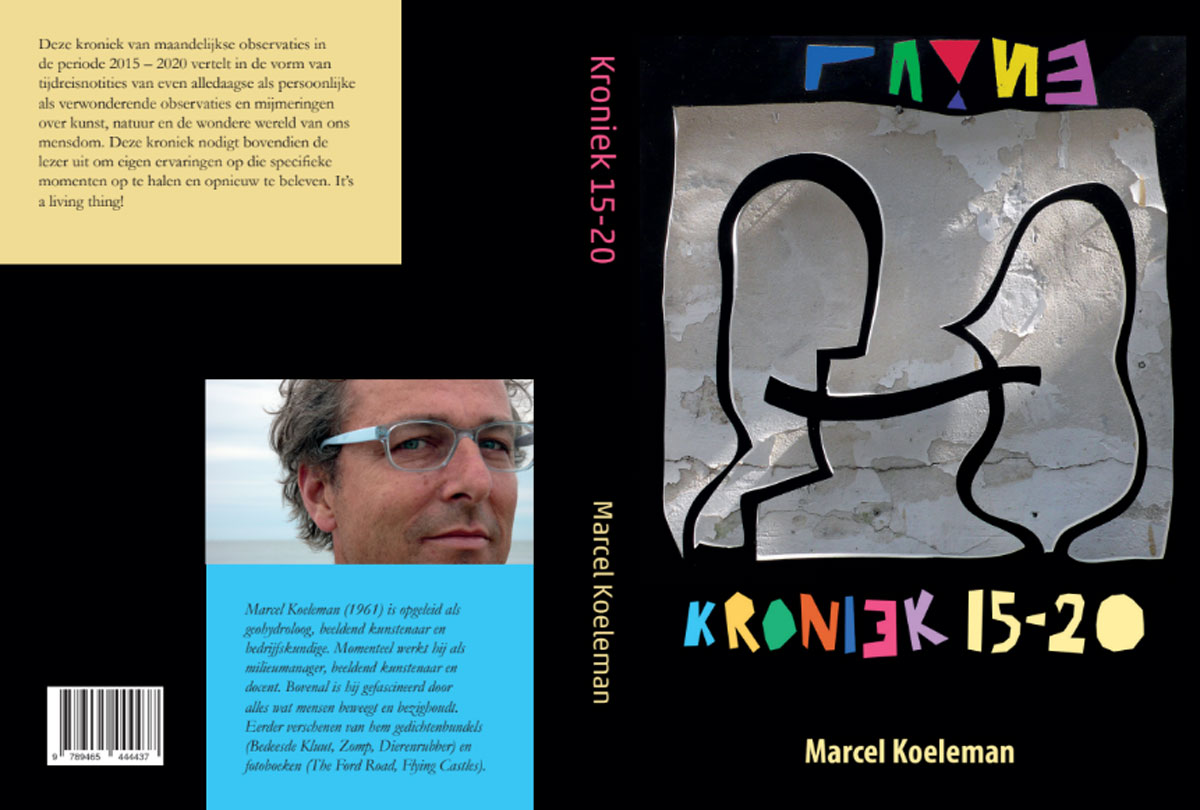
Kroniek 15-20. Tijdreisnotities
2026 (a self-published book; in Dutch; available at the artist, price 19,99 euro)
Deze kroniek van maandelijkse observaties in de periode 2015-2020 vertelt in de vorm van tijdreisnotities van even alledaagse als persoonlijke als verwonderende observaties en mijmeringen over kunst, natuur en de wondere wereld van ons mensdom. Deze kroniek nodigt bovendien de lezer uit om eigen ervaringen op die specifieke momenten op te halen en opnieuw te beleven. It’s a living thing!
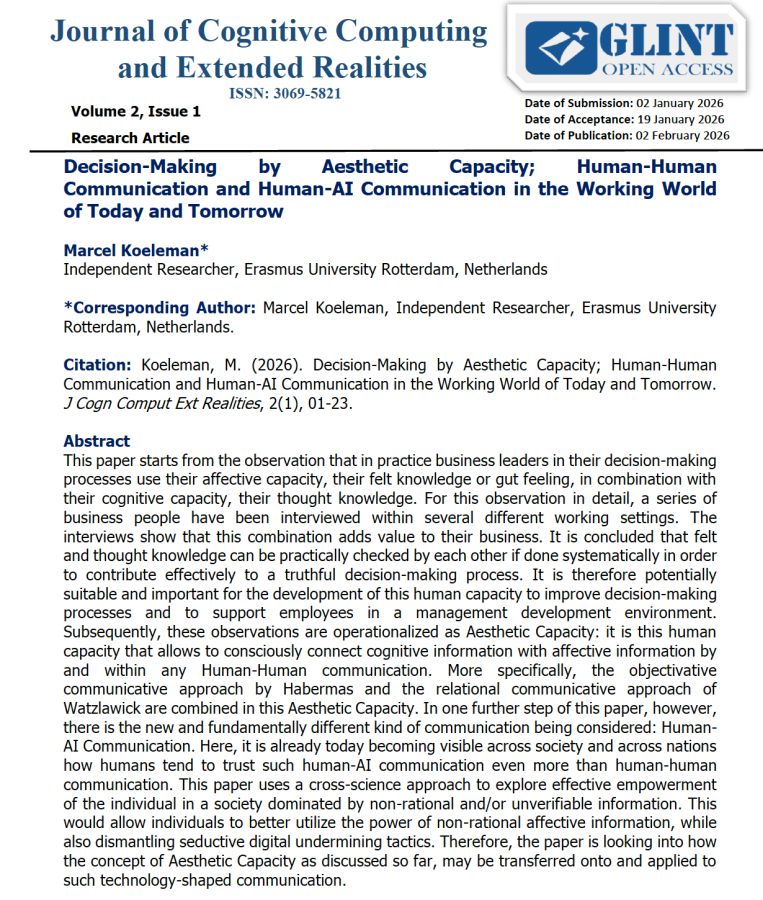
Decision-Making by Aesthetic Capacity;
Human-Human Communication and Human-AI Communication in the Working World of Today and Tomorrow.
2026 (published by Journal of Cognitive Computing and Extended Realities; in English)
This paper starts from the observation that in practice business leaders in their decision-making processes use their affective capacity, their felt knowledge or gut feeling, in combination with their cognitive capacity, their thought knowledge. For this observation in detail, a series of business people have been interviewed within several different working settings. The interviews show that this combination adds value to their business. It is concluded that felt and thought knowledge can be practically checked by each other if done systematically in order to contribute effectively to a truthful decision-making process. It is therefore potentially suitable and important for the development of this human capacity to improve decision-making processes and to support employees in a management development environment. Subsequently, these observations are operationalized as Aesthetic Capacity: it is this human capacity that allows to consciously connect cognitive information with affective information by and within any Human-Human communication. More specifically, the objectivative communicative approach by Habermas and the relational communicative approach of Watzlawick are combined in this Aesthetic Capacity.
In one further step of this paper, however, there is the new and fundamentally different kind of communication being considered: Human-AI Communication. Here, it is already today becoming visible across society and across nations how humans tend to trust such human-AI communication even more than human-human communication. This paper uses a cross-science approach to explore effective empowerment of the individual in a society dominated by non-rational and/or unverifiable information. This would allow individuals to better utilize the power of non-rational affective information, while also dismantling seductive digital undermining tactics. Therefore, the paper is looking into how the concept of Aesthetic Capacity as discussed so far, may be transferred onto and applied to such technology-shaped communication.
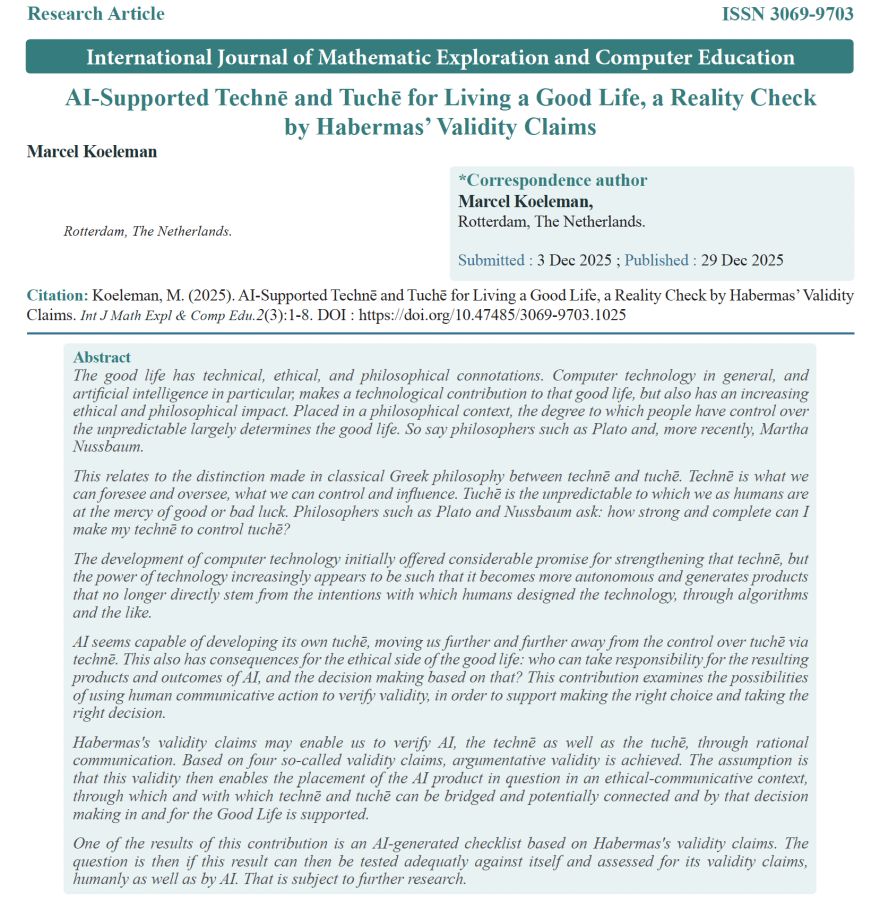
AI-Supported Technē and Tuchē for Living a Good Life, a Reality Check by Habermas’ Validity Claims.
2025 (published by International Journal of Mathematic Exploration and Computer Education; in English)
The good life has technical, ethical, and philosophical connotations. Computer technology in general, and artificial intelligence in particular, makes a technological contribution to that good life, but also has an increasing ethical and philosophical impact. Placed in a philosophical context, the degree to which people have control over the unpredictable largely determines the good life. So say philosophers such as Plato and, more recently, Martha Nussbaum.
This relates to the distinction made in classical Greek philosophy between technē and tuchē. Technē is what we can foresee and oversee, what we can control and influence. Tuchē is the unpredictable to which we as humans are at the mercy of good or bad luck. Philosophers such as Plato and Nussbaum ask: how strong and complete can I make my technē to control tuchē?
The development of computer technology initially offered considerable promise for strengthening that technē, but the power of technology increasingly appears to be such that it becomes more autonomous and generates products that no longer directly stem from the intentions with which humans designed the technology, through algorithms and the like.
AI seems capable of developing its own tuchē, moving us further and further away from the control over tuchē via technē. This also has consequences for the ethical side of the good life: who can take responsibility for the resulting products and outcomes of AI, and the decision making based on that? This contribution examines the possibilities of using human communicative action to verify validity, in order to support making the right choice and taking the right decision.
Habermas’s validity claims may enable us to verify AI, the technē as well as the tuchē, through rational communication. Based on four so-called validity claims, argumentative validity is achieved. The assumption is that this validity then enables the placement of the AI product in question in an ethical-communicative context, through which and with which technē and tuchē can be bridged and potentially connected and by that decision making in and for the Good Life is supported.
One of the results of this contribution is an AI-generated checklist based on Habermas’s validity claims. The question is then if this result can then be tested adequatly against itself and assessed for its validity claims, humanly as well as by AI. That is subject to further research.
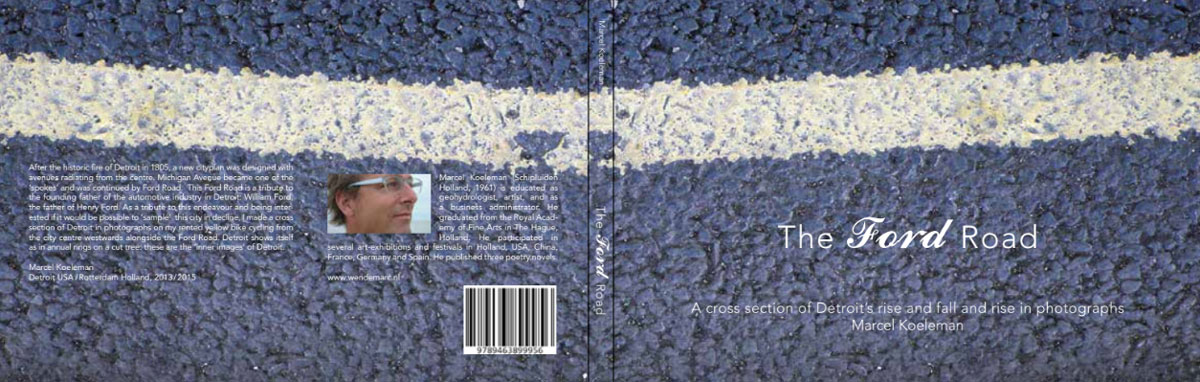
The Ford Road. A cross section of Detroit’s rise and fall and rise in photographs.
2016, tweede druk 2020 (published by publisher BoekScout and available in bookshop and amazon.com; in English; price 22,50 euro)
After the historic fire of Detroit in 1805, judge Augustus B. Woodward designed a new cityplan based on cities like Paris and later Washington DC, with avenues radiating from the centre. Michigan Avenue became one of the ‘spokes’ and was continued by Ford Road. This Ford Road is a tribute to the founding father of the automotive industry in Detroit: William Ford, the father of Henry Ford.
As a tribute to this endeavour, and being interested if it would be possible to ‘sample’ this city in decline, I took a slice out of it in photographs. I made a cross section of Detroit on thursday the 22th of June 2013, just by my rented yellow bicycle cycling from the Renaissance hotspot, what’s in a name, westwards alongside the Michigan Avenue and the Ford Road. Looking left and looking right. Up to almost Ann Arbor. I used the bicycle partly as a metaphor for the declined automotive industry of Detroit, but mostly as a modality as tranquil enough to be able to observe the city thoroughly.
The city shows itself as in annual rings on a cut tree. In fact all successive stadia of a city, flourish-decline-consolidationdevelopment, can be found alongside this cross section of approximately 25 miles. Time meets place, and vice versa. It tells also about people who left parts of the city, and locked themselves in in cars and fancy houses at the outskirts.
Yes, where are the people now in this once vibrant city?
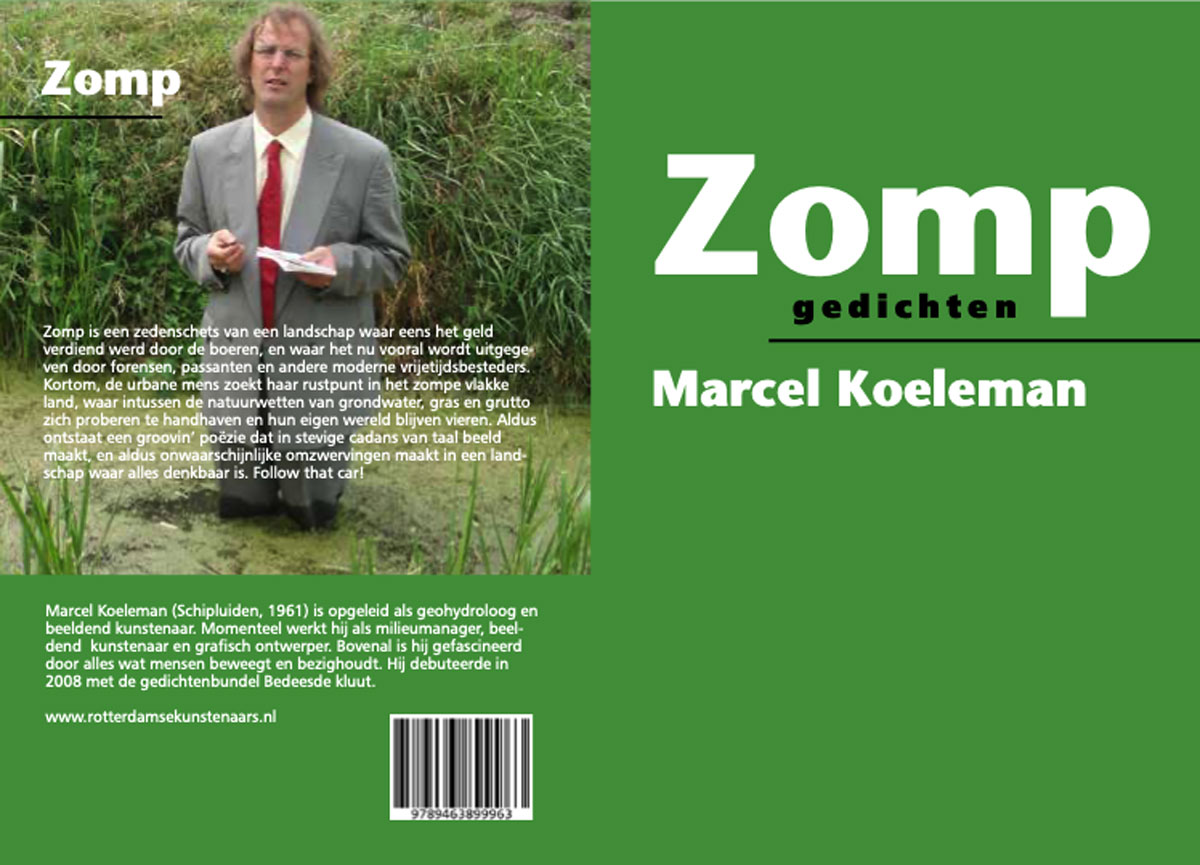
Zomp
2011, tweede druk 2020 (published by publisher BoekScout and available in bookshop and online bookshops; in Dutch; price 16,50 euro)
Zomp is een zedenschets van een landschap waar eens het geld verdiend werd door de boeren, en waar het nu vooral wordt uitgegeven door forensen, passanten en andere moderne vrijetijdsbesteders. Kortom, de urbane mens zoekt haar rustpunt in het zompe vlakke land, waar intussen de natuurwetten van grondwater, gras en grutto zich proberen te handhaven en hun eigen wereld blijven vieren. Aldus ontstaat een groovin’ poëzie dat in stevige cadans van taal beeld maakt, en aldus onwaarschijnlijke omzwervingen maakt in een landschap waar alles denkbaar is. Follow that car!
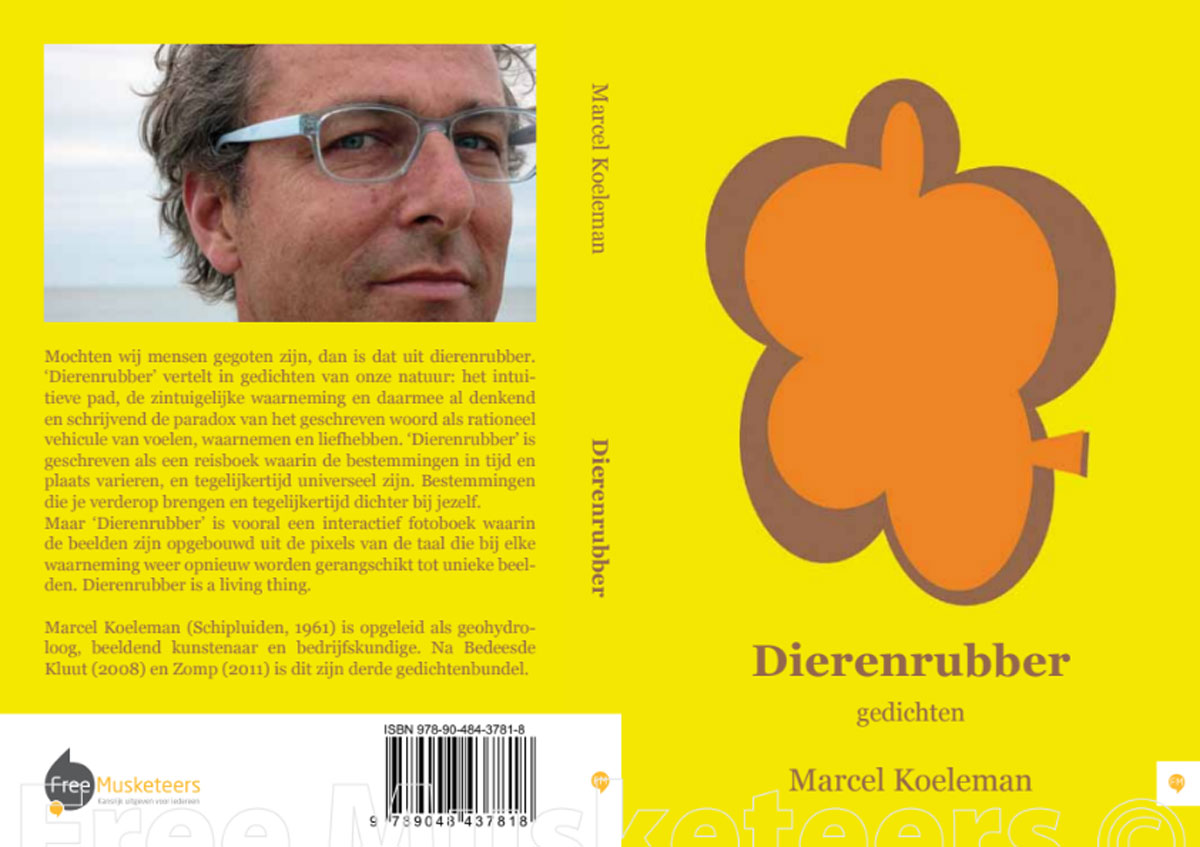
Dierenrubber
2015 (published by publisher BoekScout and available in bookshop and online bookshops; in Dutch; price 19,50 euro)
Mochten wij mensen gegoten zijn, dan is dat uit dierenrubber. ‘Dierenrubber’ vertelt in gedichten van onze natuur: het intuitieve pad, de zintuigelijke waarneming en daarmee al denkend en schrijvend de paradox van het geschreven woord als rationeel vehicule van voelen, waarnemen en liefhebben. ‘Dierenrubber’ is geschreven als een reisboek waarin de bestemmingen in tijd en plaats varieren, en tegelijkertijd universeel zijn. Bestemmingen die je verderop brengen en tegelijkertijd dichter bij jezelf.
Maar ‘Dierenrubber’ is vooral een interactief fotoboek waarin de beelden zijn opgebouwd uit de pixels van de taal die bij elke waarneming weer opnieuw worden gerangschikt tot unieke beelden. Dierenrubber is a living thing.
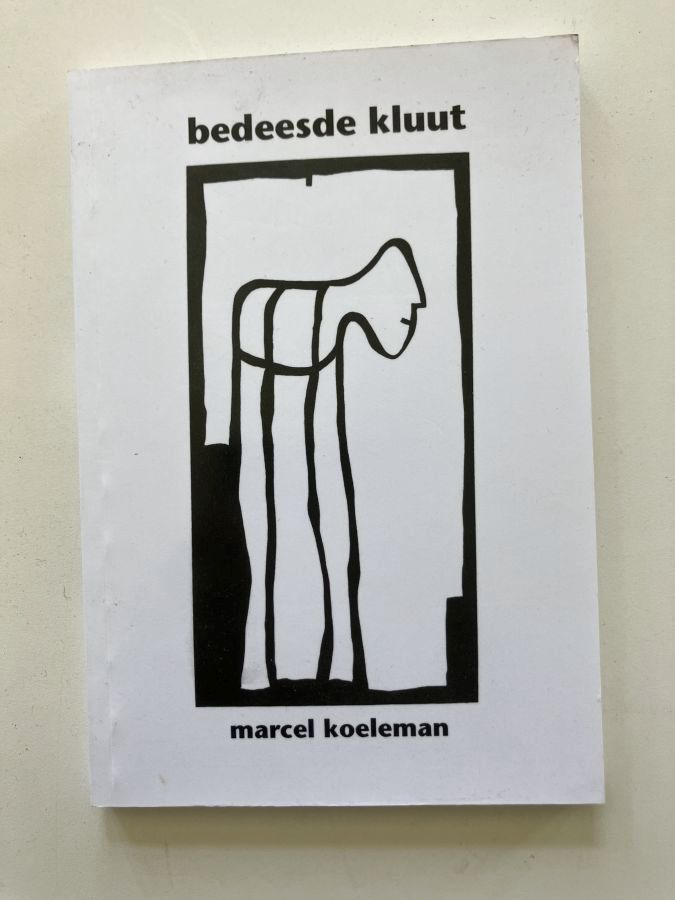
Bedeesde Kluut
2008 (published by publisher FreeMusketeers; in Dutch)
De werkelijkheid van de waarneming, van de zintuiglijke waarneming, is tegelijkertijd zo echt en zo raadselachtig dat het leidt tot iets nieuws, iets onverwachts. Deze gedichtenbundel vertelt van deze nieuwe werkelijkheid. Beeld wordt taal en taal wordt weer beeld. In een eigen vorm en inhoud die zich kan nestelen in ieders individuele wereld waarin herinnering, melancholie, geluk, verdriet en verwondering worden aangewakkerd door de alledaagsheid van de roepende mus op de tak van die seringenboom achterin de tuin tegen de schutting. In alle schijnbare eenvoud.
[met houtgrafiek illustraties]